mental health

mental health, psychoanalysis, psychotherapy

Psychoanalysis in Argentina – New York Times article
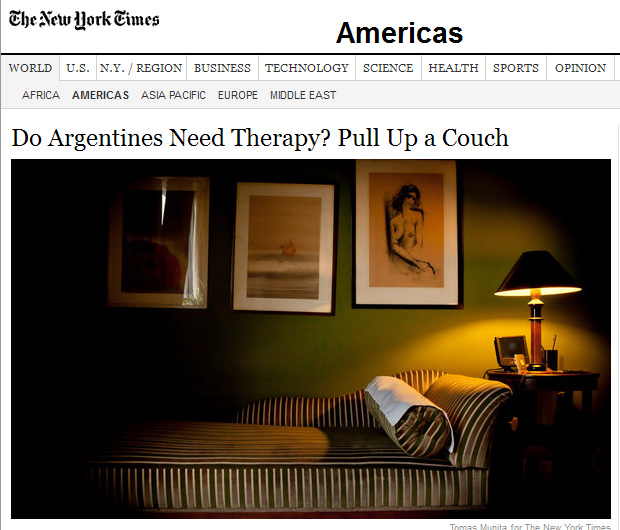
Peter Owen - Psychoanalysis in Bristol - Blog post on Agentinian psychoanalysis

[click here to read the whole article on the New York Times site.]

“There is no taboo here about saying that you see a professional two or three times a week,” said Tiziana Fenochietto, 29, a psychiatrist doing her residency at the Torcuato de Alvear Hospital for Psychiatric Emergencies, a public institution. “On the contrary,” said Ms. Fenochietto, who has been in therapy herself for the past eight years, “it is chic.”

One need not wander far in this city to get a grip on the resilient obsession with neuroses of various stripes. The name Villa Freud is a nod not only to the Austrian founding father of psychoanalysis, but also to the number of psychologists who ply their trade in the buildings along the elegant streets around Plaza Güemes, in northern Buenos Aires.

A short cab ride away, in the theater district along Avenida Corrientes, lines form each night where the local adaptations of two hit plays have opened side by side: “Freud’s Last Session,” currently an imagined debate between Sigmund Freud and C. S. Lewis, and “Toc Toc,” about obsessive-compulsive disorder.

Slip into many bookstores here, and tomes abound written by Argentines about the psychological ills that plague people, and their cures. Malele Penchansky’s “Universal History of Hysteria” and Alejandro Dagfal’s “Between Paris and Buenos Aires: The Invention of the Psychologist” are among the offerings. A new prizewinning Argentine comic book, “Repairer of Dreams,” even blends psychoanalysis into the tale of a dystopian city called Polenia.

Psychoanalysis is not just for Argentina’s moneyed classes, with some psychoanalysts in the state medical system offering patients free sessions. And while some private health plans do not pay for psychoanalysis, insurance programs for some unionized workers cover dozens of therapy sessions a year.
, , ,
DSM, mental health, psychoanalysis, psychotherapy

Darian Leader – The Bipolar Explosion

Darian Leader - bipolar[Click here to read the whole article on the Guardian site.]

Discussion this week about appalling cuts to mental health services focused on the diagnostic categories “depression” and “anxiety”. Though there are good reasons to question and critique the use of these terms, they have drawn attention away from a major redrafting of diagnostic and prescription trends. While it is claimed that up to one in four people will suffer from depression at some point, over 25% of these subjects are now likely to receive a diagnosis not of depression but of bipolar disorder.

In the early 20th century the prevalence of manic depression was put at less than 1% of the population, but this figure exploded with the ramification of the bipolar categories. If bipolar 1 was often equated with classical manic depression, bipolar 2 lowered the threshold dramatically, requiring merely one depressive episode and one period of increased productivity, inflated self-esteem and reduced need for sleep.

Bipolar 2 and a half, 3, 3 and a half, 4, 5 and 6 soon followed. Today there is even “soft bipolar”, which means a patient “responds strongly to losses”. The World Health Organisation deems bipolar the sixth main cause of disability for people aged 15-44. In children, the diagnosis has increased by over 400%.

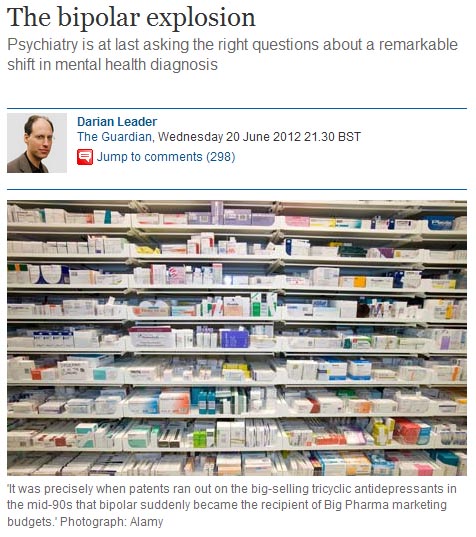
Historians of psychiatry have all made the same observation: it was precisely when patents ran out on the big-selling tricyclic antidepressants in the mid-90s that bipolar suddenly became the recipient of Big Pharma marketing budgets. Websites helped people to diagnose themselves; articles and supplements appeared all referring to bipolar as if it were a fact; and nearly all of these were funded by the industry.

, , , , ,
DSM, mental health, psychotherapy

Dr. David Healy: A Self-Effacing Scholar Is Psychiatry’s Gadfly


Dr David Healy[Click here to read the whole article on the Telegraph site.]

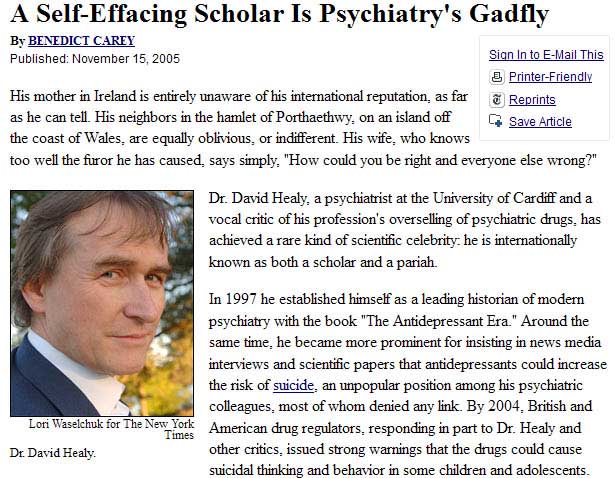
Dr. David Healy, a psychiatrist at the University of Cardiff and a vocal critic of his profession’s overselling of psychiatric drugs, has achieved a rare kind of scientific celebrity: he is internationally known as both a scholar and a pariah.

In 1997 he established himself as a leading historian of modern psychiatry with the book “The Antidepressant Era.” Around the same time, he became more prominent for insisting in news media interviews and scientific papers that antidepressants could increase the risk of suicide, an unpopular position among his psychiatric colleagues, most of whom denied any link. By 2004, British and American drug regulators, responding in part to Dr. Healy and other critics, issued strong warnings that the drugs could cause suicidal thinking and behavior in some children and adolescents.

But Dr. Healy went still further, accusing academic psychiatry of being complicit, wittingly or not, with the pharmaceutical industry in portraying many drugs as more effective and safer than the data showed.

He regularly gets invitations to lecture around the world. But virtually none of his colleagues publicly take his side, at least not in North America.

, , , ,
Scroll to Top