Bristol

Darian Leader, mental health, psychoanalysis, psychotherapy, talking treatment, Therapy

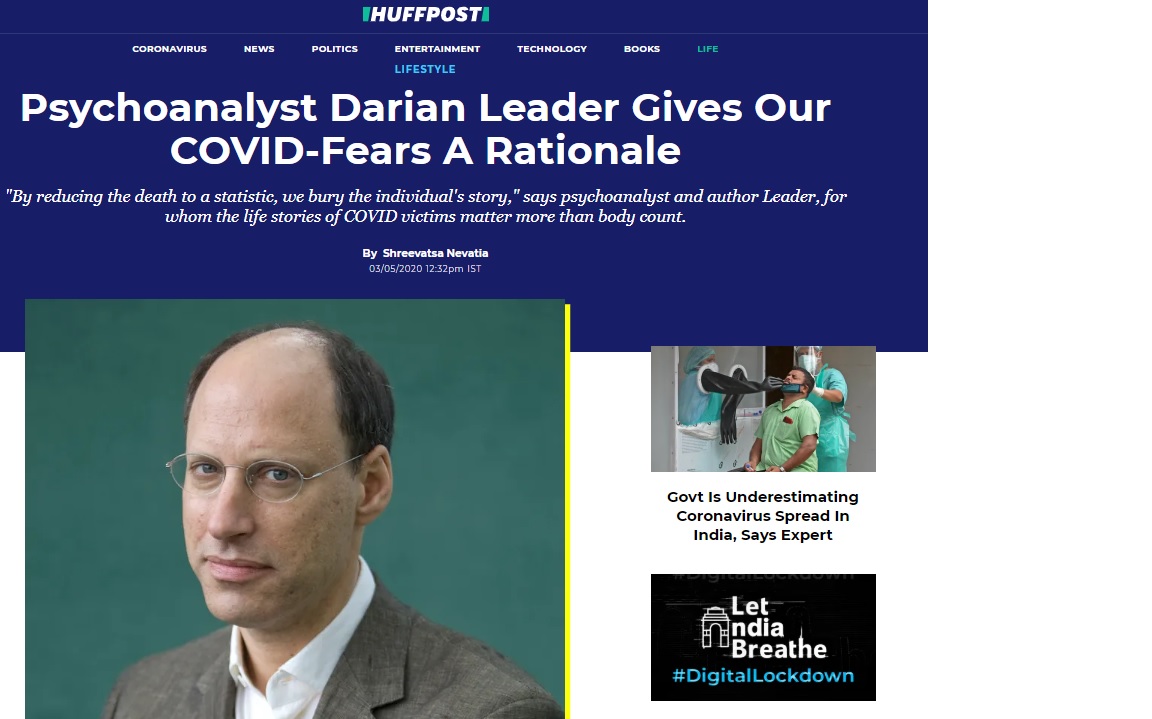
Psychoanalyst Darian Leader on the Covid-19 Pandem

Darian Leader - Covid-19

[Read the full article here on the Huffington Post Site]

“I see a lot of people during the lockdown finding isolation more positive than negative in the sense that they want to have space of their own. Again, the socio-economic factors have to be recognised here. For most people in the world, a lockdown doesn’t mean being on your own because you are in a small place with a lot of other people. You might be living in one room with your family or people that you work with, so it’s only a privilege for some to be able to retreat. In terms of my practice, though, a lot of people say they find the lockdown a great relief.”

, , , , , , , , ,
Bristol, CFAR/Bristol University, Culture, Freud, mental health, psychoanalysis, psychotherapy, talking treatment

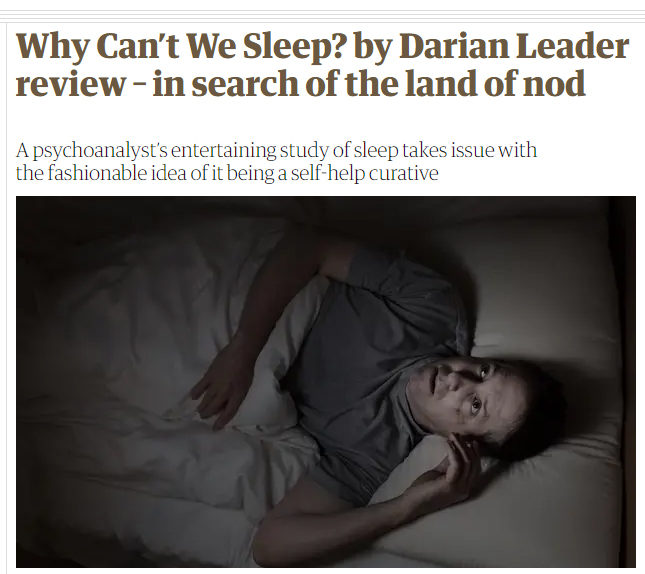
Darian Leader – Why Cant We Sleep?

In the 1950s, researchers at Edinburgh University conducting a study into sleep concluded that there was little difference in sleep time between using a well-sprung mattress and a wooden board. Try telling that to retailers of £500 multilayered mattresses. For sleep, as the psychoanalyst Darian Leader reminds us in his richly researched and entertaining Why Can’t We Sleep?, has been commodified: it’s big business.

Before advancing reasons for insomnia, and why one in three adults complains of sleep difficulties, Leader delves into the history of sleep research and competing theories about why we sleep, which have culminated in a remarkable inversion of concern: a shift from anxiety causing problems with sleep to the present, where the lack of sleep leads to anxiety.

Some judgments, though, have resisted change. In the 1960s the eight-hour “ideal” sleep was shown by the researcher William Dement to be a “fallacy”, yet today, argues Leader, sleep experts promote eight hours as the desired gold standard – almost as a human right.

Leader rolls his eyes at the zeitgeist of the “new science of sleep”, with its notions of sleep as a self-help curative for ailments ranging from dementia to unhappiness, all achievable “with sensitive temperature control and software that will tailor the environment to their unique circadian rhythm”.

There’s no consensus on the point of sleep. But there is agreement that it is a time for the processing of memories internal body clocks’ association with sleep cycles have long been recognised, but sleep wasn’t always undertaken in one unbroken block. The historian Roger Ekirch argued that prior to the 19th century sleep was biphasic – taken in two parts with an hour or so in between when the person was awake.

With the Industrial Revolution, maintaining nonstop production lines necessitated shift work and changes to patterns of sleep. Today, businesses’ co-option of sleep in enhancing productivity is illustrated by firms such as Aetna offering $25-per-night rewards to employees (monitored via sleep trackers) who manage 20 nights of sleep for seven hours or more in a row.

Goal-oriented sleep research becomes problematic when it approximates the maxim: “What the thinker thinks the prover proves.” We might be inclined to look more closely at conclusions drawn by Nathaniel Kleitman’s classic 1939 study Sleep and Wakefulness, says Leader, when made aware that his university research “was heavily funded by corporate sponsors keen to engineer more productive workers”.

Leader also questions the value of extrapolating into the real world conclusions drawn from experiments carried out in unnatural environments. Contemplating the validity of experiments with patients isolated overnight in sleep clinics using EEG, he observes: ‘They don’t have sex with a bedfellow or masturbate, and yet this entirely artificial subject is the one we expect to give the real facts about sleep.”

[Click here to read the rest of this article on the Guardian Site]

Darian Leader is speaking in Bristol at the CFAR/Bristol University Lecture Series on the 22nd of June 2019.
, , , , , , , , , ,
Culture, Freud, Freud Museum, mental health, psychoanalysis, psychotherapy, talking treatment

What is Psychoanalysis? Part 4: The Ego, the Id and the Superego – Freud Museum

Ego Id Superego

IN THIS EPISODE:
A fractured self
The ego, the id and the superego
Why did Freud develop a new model?
Devils and angels
People fall ill of their moral ideals
A horse and a rider
The ego is like a politician
The goal of analysis is to stop the ego being so silly

More info: www.freud.org.uk/education/

, , , , ,
Culture, Freud, Freud Museum, psychoanalysis, psychotherapy, talking treatment

What is Psychoanalysis? Part 3: Oedipus Complex – Freud Museum London

psychoanalysis - oedipus

Click here to see the third part of the Freud Museum introductory video series on psychoanalysis.

IN THIS EPISODE:
The emotional world of children
His Majesty the Baby
The mother as first love object
Is it sexual?
Jealousy, rivalry, hatred and anxiety
The role of the father
Gender: Freud didn’t think you were just ‘born a boy’ or ‘born a girl’
There is no perfect resolution of the Oedipus complex
It marks us for life

More info: www.freud.org.uk/education/

, , , ,
Courtil, Culture, mental health, psychoanalysis, psychotherapy, talking treatment

‘Like An Open Sky’ – a documentary about the ‘Courtil’ treatment centre for children

It’s very good to hear that Mariana Otero’s acclaimed film about Le Courtil, the Lacanian-oriented treatment centre on the French-Belgium border for children, adolescents and adults with mental health problems, will be released with subtitles in the UK in October. We’ll try to see about getting a showing in Bristol somehow…

like-an-open-sky

“Alysson considers her body with mistrust. Evanne spins and twists until he collapses. Amina can’t manage to make words come out of her mouth. At the border between France and Belgium there exists a special place which takes care of psychologically and socially challenged children. Day after day, the adults working there try to understand the enigma that each of these children represent and invent, case by case, without ever imposing anything, solutions that will help them live peaceful lives.”

Click the image below to watch the trailer for the film on YouTube: open sky

, , , , , , ,
Artistic process, Culture, mental health, psychotherapy

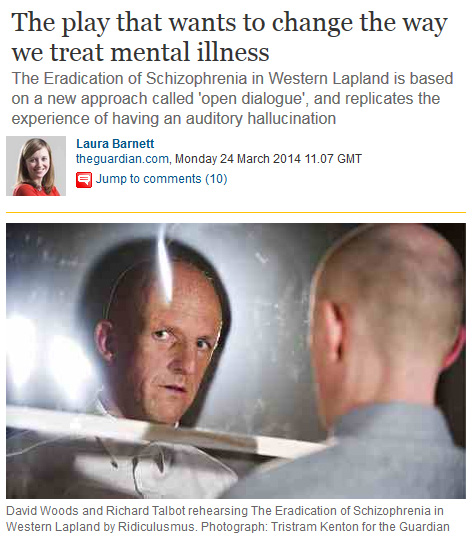
The play that wants to change the way we treat mental illness

lapland schitzophreniaCan theatre offer a cure for psychosis? It’s unlikely – and it would be unwise for any theatre-maker even to try. What theatre can do, though, is convey the experience of psychosis: the hallucinations and delusions – often terrifying, sometimes comical – that define reality for those with schizophrenia and related conditions. [Click here to read the rest of the article on the Guardian site.]

, , , , ,
DSM, mental health, psychoanalysis, psychotherapy

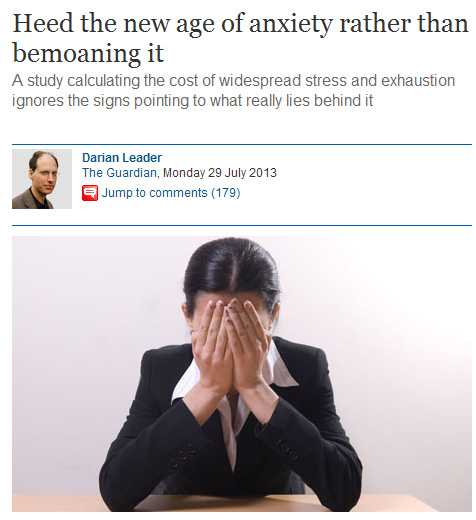
Darian Leader: “Heed the new age of anxiety rather than bemoaning it”

Lacanain Psychoanalyst Darian Leader on Anxiety


[Click here to read the whole article on the Guardian Website]

If the postwar age of anxiety was supposed to have ended 30 or 40 years ago, a swath of media articles now suggest a dramatic comeback. A new and widely reported study claims a massive increase in anxiety disorders in the UK, with an estimated 8.2 million sufferers compared to 2.3 million in 2007. The pressures of modern life, we are told, must play a large part here, with job stress aggravating the difficulties of urban populations.

The focus on socio-economic conditions is surely a good thing. In the 1980s, Thatcherism encouraged a redrafting of work-related problems as psychological ones. As each person became a unit of economic competition, it wasn’t the market’s fault if they didn’t get a job but their own. Injustice in the marketplace was glossed over as individual failure.

Hundreds of books and articles have questioned this without gaining media exposure, so why the visibility of the new research? I was puzzled to find not a single sentence in the report linking the supposed increase in anxiety to social causes. In fact, there was no explanation at all, and the headline-grabbing prevalence rate for the UK was estimated from Iceland, Norway and Switzerland.

Here, we find a perfect expression of the new mental hygiene movement. Anxiety is grouped together with dementia, stroke and neuromuscular conditions as a “brain disorder”, and the authors urge an approach that uses “comparable methodologies for both mental and neurological illness”. Disorders are listed in terms of their cost to the economy rather than to individual lives, families and communities. […]

, , , , ,
Culture, mental health, psychoanalysis, psychotherapy

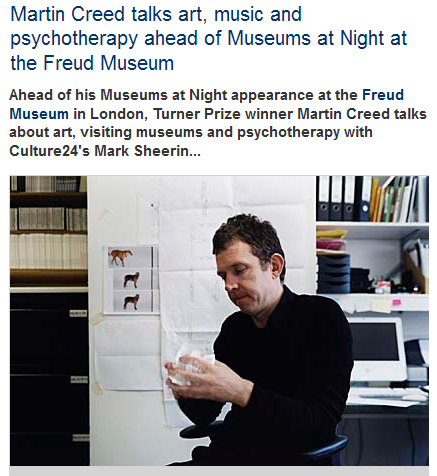
Artist Martin Creed on his own psychoanalysis.

martin creed art psychoanalysis bristol

[Click here to read the whole article on Culture24.org.uk]

Anyone with more than a passing acquaintance with the practice of artist Martin Creed will know all about the fastidious numbering of his works. These begin with Work No.3 in 1986 (a yellow painting) and so far stretch as far as this year’s Work No. 1461 (an installation made with adhesive tape).

What might surprise you is that Creed’s appetite for order and record keeping extends to collecting sound files of every interview he undertakes. So when I catch him on the phone a technical hitch at his end throws the methodical artist.

“Wait, are you recording this?” he wants to know. “Can I get a copy of it?” And after the giving and receiving of assurances that I will later send him an MP3, we are ready to continue. It is quite clear that Creed takes the business of talking seriously.

This bodes well for those lucky enough to find themselves at the Freud Museum during Museums at Night 2013. On Thursday May 16 the Scottish artist will be on the spot, if not on the couch, as he improvises an after hours lecture, with the help of slide projections and a bit of music.

“It’s hard to do things,” he says. “Everything seems just as difficult as everything else: it’s just as much work to try to talk and say something that I think is alright as it is to try to fix and be okay with the shapes or colours in a painting or a sculpture or whatever.”

Creed refuses to be drawn about finer details pertaining to the evening: “I’m not sure — I’ll probably try just to think out loud and talk about whatever comes up”.

But he does admit the event should resonate with his newfound surroundings. “Absolutely, aye,” he says, “I do psychoanalysis and I’m a fan of Freud. Yeah, I have been [in analysis] for a very long time.”

Creed reveals he first saw an analyst in 1993: “I did it because I was desperate. I wanted to speak to someone.” Now he goes four times a week. “It’s a bit like going swimming or something like that: I think it’s an integral part of my life.”

At any rate, intensive therapy is clearly commensurate with a blue chip art career. This most exacting of artists views the activity as labour: “It’s work and I feel like I have to keep doing it.” This may come as some surprise, considering how effortless the artist’s official numbered works appear to be…

, , , ,
mental health, psychoanalysis, psychotherapy

UKCP Event: ‘Black men on the couch: talking therapy’


UKCP ‘Black men on the couch: talking therapy’ – 12 May 2012 – RADA Studios, London from Lydia Dumont on Vimeo.
A sell-out event in the ‘Black Men on the Couch’ series took place with guests Ashley Walters (Hustle, Top Boy, Inside Men) and Stuart Lawrence (brother of Stephen Lawrence). Fascinating and moving by turn, the evening revealed some of the different struggles and obstacles in life overcome by both Ashley and Stuart and provided an insight into just how valuable it is to talk about them.

, , ,
mental health, psychoanalysis, psychotherapy

‘Strictly Bipolar’ – Darian Leader at the Bristol Festival of Ideas – 18th May 2013

Darian Leader - psychoanalyst - Bristol Watershed Festival of Ideas

‘Strictly Bipolar’ – Darian Leader at the Bristol Festival of Ideas – 18th May 2013

Click here to read the full article on the Watershed Website.

Strictly Bipolar is Darian Leader’s treatise on the psychological disorder of our times.If the post-war period was called the ‘Age of Anxiety’ and the 1980s and ’90s the ‘Antidepressant Era’, we now live in Bipolar times. Mood-stabilising medication is routinely prescribed to adults and children alike, with child prescriptions this decade increasing by 400% and overall diagnoses by 4000%. What could explain this explosion of bipolarity? Is it a legitimate diagnosis or the result of Big Pharma marketing?

Exploring these questions, Darian Leader challenges the rise of ‘bipolar’ as a catch-all solution to complex problems, and argues that we need to rethink the highs and lows of mania and depression. What, he asks, do these experiences have to do with love, guilt and rage? Why the spending sprees and the intense feeling of connection with the world? Why the confidence, the self-esteem and the sense of a bright future that can so swiftly turn into despair and dejection? Only by looking at these questions in a new way will we be able to understand and help the person caught between feelings that can be so terrifying and so exhilarating, so life-affirming yet also so lethal.

, , , , ,
Scroll to Top