Artistic process, Culture, mental health, psychoanalysis, psychotherapy, talking treatment, Writing

Springsteen: “The Boss” and Psychoanalysis – by Thomas Svolos
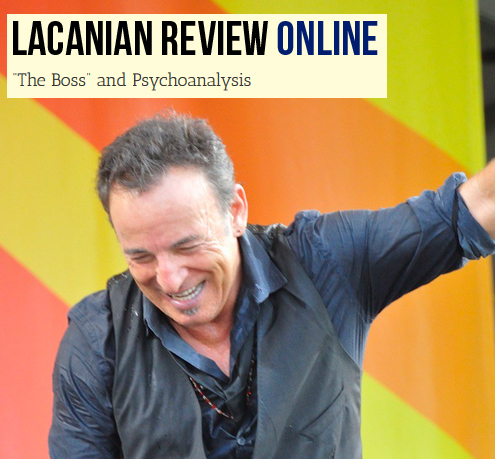
Thomas Svolos writes in The Lacanian Review [read the whole article here]: 

“In the United States, many Americans within a generation or two of my age—meaning, many Americans—recognize the musician Bruce Springsteen as “The Boss.”  Springsteen’s songwriting, his lyrics, and his marathon, high energy concert performances have, for decades, attracted fans across the country, critical and popular acclaim, and enormous success.  He has been at the very top of the pop/rock music industry.

Springsteen recently published an autobiography, titled Born to Run, named after his 1975 breakout album.  I recently read this book and was immediately struck by the high level of awareness in his writing.  To me, his songs have always been straight up with a lyrical quality to them that, however, could have easily fallen flat, but—coming through in the songs and in his performances—Springsteen’s internal sensitivities and external perceptiveness elevate them to something very special in the pop/rock world.  This same quality of awareness comes through in the book as well, especially the first half or so up to his achievement of fame and major recognition.  Indeed, he spends a lot of time very carefully describing his background growing up in a tough, blue collar part of New Jersey with a stern and difficult father and the way in which he struggled to find both personal and professional identity (a word he uses often) and in which he developed his passion for the guitar, for playing music, and eventually for singing and writing.  He writes with this great awareness for what he is experiencing internally, as it were, and also the ways in which his relationships and the world he grew up in impacts his playing, the ways in which he works with his various groups, and the very themes of his songs and albums.  One thing he emphasizes is the very determined desire he had—his ambition for himself and for his music.

At one point, he has made it, achieved some serious recognition, and decides that he will travel across the United States—take a road trip—with a close friend.  Driving across Texas, he stops in a small town, watches the small town dance and celebrate one evening, and this, he writes, brings on a deep sense of dread and anguish—”a deeper anxiety than I’ve ever known.” Springsteen is paralyzed.  He talks about being, at that point in his life, forced finally to confront something that he had been defending against all his life (“the defenses I built… outlived their usefulness”), something that his passion, his ambition, and his desire was shielding himself from—something he allusively describes through the book as darkness, depression—what strikes me as some piece of the Real.  And, at that point in the book, some 300 pages in, he writes that he sought out counsel from his manager, a friend, who finds a professional for him to see in California, and that he is eventually referred to Wayne Myers, a New York psychoanalyst.  He writes that he saw his psychoanalyst for twenty five years: “The results of my work with Dr. Myers and my debt to him are at the heart of this book.”

[read the rest of the article here]…

, , , , , ,
Freud, mental health, psychoanalysis, psychotherapy, talking treatment

Pope reveals he had weekly psychoanalysis sessions at age 42

Pope Francis has revealed that he sought the help of a psychoanalyst for six months when he was 42 and the leader of the Jesuit order in Argentina during the country’s military dictatorship.

The pope’s disclosure was made in a book based on 12 in-depth interviews with the French sociologist Dominique Wolton, to be published next week.

Francis said the weekly sessions with the psychoanalyst helped him a lot. “For six months, I went to her home once a week to clarify a few things. She was a doctor and psychoanalyst. She was always there,” he told Wolton for the 432-page book Pope Francis: Politics and Society.

[Read the rest of the article on the Guardian website]

, , , , , , ,
psychoanalysis

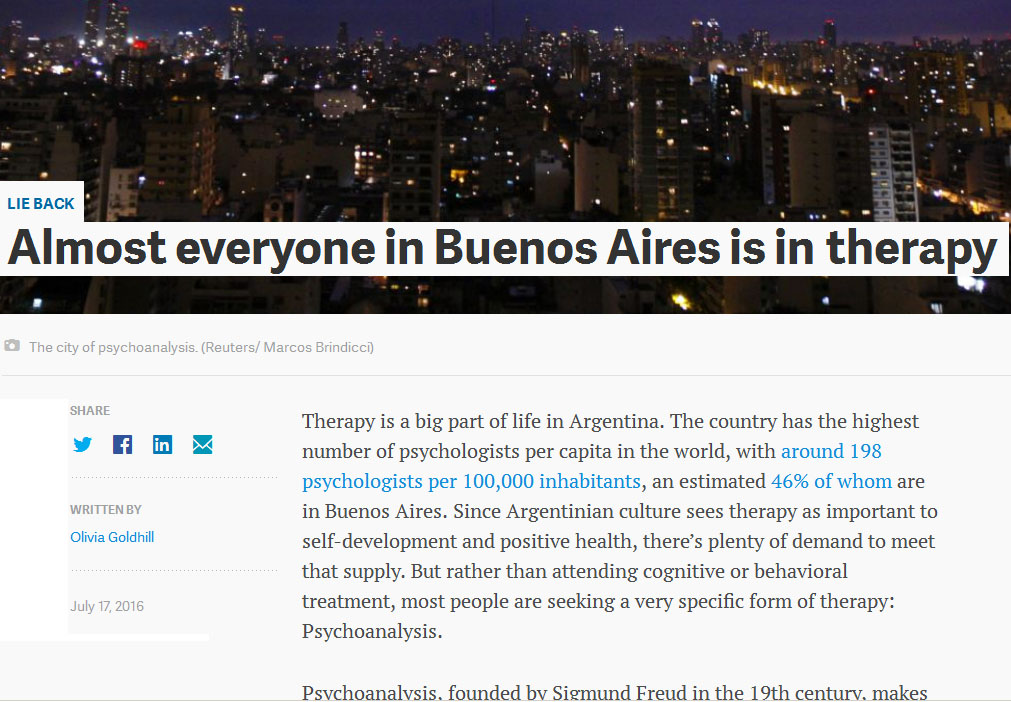
Almost everyone in Buenos Aires is in Therapy – Olivia Goldhill – Quartz

Therapy

[Click here to read the original on qz.com]

Therapy is a big part of life in Argentina. The country has the highest number of psychologists per capita in the world, with around 198 psychologists per 100,000 inhabitants, an estimated 46% of whom are in Buenos Aires. Since Argentinian culture sees therapy as important to self-development and positive health, there’s plenty of demand to meet that supply. But rather than attending cognitive or behavioral treatment, most people are seeking a very specific form of therapy: Psychoanalysis.

Psychoanalysis, founded by Sigmund Freud in the 19th century, makes use of fantasies, dreams, and free association speech to uncover repressed ideas in the unconscious and help the patient gain new insights into their emotions and experiences.

Mariano Plotkin, history professor at Universidad Nacional de Tres de Febrero and the leading authority on the history of psychoanalysis in Argentina, explains that although psychoanalysis was known in Buenos Aires since the 1910s, it experienced a cultural boom after dictatorial President Juan Perón was overthrown in 1955.

“That opened a moment of fast cultural modernization in Argentina,” says Plotkin. “There was a big reception of anything coming from Europe. Psychoanalysis was seen by many as a emancipatory doctrine.”

Certain well-known psychologists such as Enrique Pichon-Rivière had immigrated to Argentina, so the country had a strong foundation of psychoanalytic knowledge, adds Andrew Lakoff, a sociology professor at the University of Southern California who has conducted research on psychoanalysis in Argentina. Among Buenos Aires’ educated middle-class, there was a lot of prestige associated with self-improvement.

During the 1960s and 1970s, Lakoff says, psychoanalysis became not just a “prestigious way of understanding and forming oneself,” but also linked to a leftist political ideology.

During the cultural suppression of dictatorships during the 1970s, psychoanalysis was seen as subversive. A group called Federación Argentina de Psiquiatras linked psychoanalysis with Marxist theory; this group was targeted by the military and, Lakoff says, psychoanalysts struggled to find jobs or publish their work. “With the return to democracy in 1983, it was again prestigious because it was associated with resistance to totalitarianism,” he adds.

Another key moment for psychoanalysis in Argentina, says Plotkin, was when the intellectual Oscar Masotta introduced the ideas of French psychoanalyst Jacques Lacan to Argentina with a series of lectures and books in the 1970s.

“If you talk about psychoanalysis in Buenos Aires today, you’re really talking about Lacan French psychoanalysis. Argentine intellectual elites were always very receptive to everything coming from France,” he explains. “The infatuation with French culture is a broad phenomenon along Latin America, except that here [in Buenos Aires] there’s a larger population of middle-class who had access to these cultural artifacts.”

Indeed, many Argentina universities today have huge psychology departments, nearly exclusively devoted to the study of various aspects of Lacanian psychoanalysis.

The academic focus on this field of psychology has helped maintain a steady supply of professional psychoanalysts. Lakoff explains that psychoanalysts don’t need a medical degree and, after getting an undergraduate degree of psychology, can begin training to be a psychoanalyst.

Though some psychoanalysts are pricey, there are plenty of inexpensive options available, with the cheapest therapy sessions costing around 150 Argentinean pesos ($10.)

Artistic process, Culture, mental health, Music, psychoanalysis, psychotherapy, talking treatment, Writing

Psychoanalyst & Author Anouchka Grose on life, training and practice as a psychoanalyst.

Recorded at the launch event of Lambeth and Southwark MIND psychotherapy clinic, psychoanalyst and author Anouchka Grose talks with Ajay Khandelwal about her life, the difficulties that took her into analysis as well as her subsequent training and practice as a psychoanalyst.

, , , , , , ,
Freud, mental health, psychoanalysis, psychotherapy, talking treatment

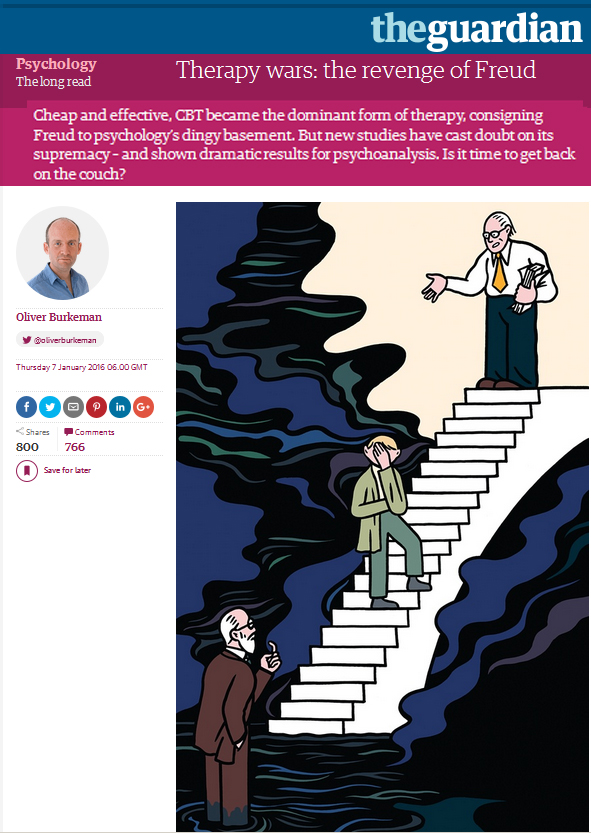
Therapy Wars: The Revenge of Freud – Guardian Article by Oliver Burkeman

therapy wars

[Click here to visit the Guardian site and read Oliver Burkeman’s article.]

Cheap and effective, CBT became the dominant form of therapy, consigning Freud to psychology’s dingy basement. But new studies have cast doubt on its supremacy – and shown dramatic results for psychoanalysis. Is it time to get back on the couch?

“…researchers at London’s Tavistock clinic published results in October from the first rigorous NHS study of long-term psychoanalysis as a treatment for chronic depression. For the most severely depressed, it concluded, 18 months of analysis worked far better – and with much longer-lasting effects – than “treatment as usual” on the NHS, which included some CBT. Two years after the various treatments ended, 44% of analysis patients no longer met the criteria for major depression, compared to one-tenth of the others.”

, , , ,
Culture, Freud, Freud Museum, mental health, psychoanalysis, psychotherapy, talking treatment

What is Psychoanalysis? Part 4: The Ego, the Id and the Superego – Freud Museum

Ego Id Superego

IN THIS EPISODE:
A fractured self
The ego, the id and the superego
Why did Freud develop a new model?
Devils and angels
People fall ill of their moral ideals
A horse and a rider
The ego is like a politician
The goal of analysis is to stop the ego being so silly

More info: www.freud.org.uk/education/

, , , , ,
Culture, Freud, Freud Museum, psychoanalysis, psychotherapy, talking treatment

What is Psychoanalysis? Part 3: Oedipus Complex – Freud Museum London

psychoanalysis - oedipus

Click here to see the third part of the Freud Museum introductory video series on psychoanalysis.

IN THIS EPISODE:
The emotional world of children
His Majesty the Baby
The mother as first love object
Is it sexual?
Jealousy, rivalry, hatred and anxiety
The role of the father
Gender: Freud didn’t think you were just ‘born a boy’ or ‘born a girl’
There is no perfect resolution of the Oedipus complex
It marks us for life

More info: www.freud.org.uk/education/

, , , ,
Freud, Freud Museum, psychoanalysis, psychotherapy, talking treatment

What is Psychoanalysis? Part 2: Sexuality – Freud Museum London

psychoanalysis - sexuality

Click here to see the second part of the Freud Museum introductory video series on psychoanalysis. 

IN THIS EPISODE:
An enlarged concept of sexuality
Infantile sexuality
Perversion is something we’re born with
Normal and abnormal
Psychosexual stages of development: oral, anal, phallic
Repression
Sexuality and symptoms

More info: www.freud.org.uk/education/

, ,
Culture, mental health, psychoanalysis, psychotherapy, talking treatment

Oliver Sacks on his analysis: ‘The longest running psychoanalysis on record’

Oliver Sacks

Please click here to visit ‘Web of Stories’ site and listen to Oliver Sacks the neurologist and author of Awakenings and The Man Who Mistook His Wife for a Hat talking about his 46-year-long analysis. “I think that we are beginning to get somewhere now…”

, ,
Culture, Freud, Freud Museum, Podcast, psychoanalysis, talking treatment

What is Psychoanalysis? Part 1: Is it Weird? Freud Museum London

What is psychoanalysis

[Click here to view the Freud Museum video on YouTube]

Series trailer for Freud Museum introductory videos on psychoanalysis featuring interviews with analysts including  John Forrester, Anne Worthington, Dany Nobus, Darian Leader, Astrid Gessert, Daniel Pick and Anouchka Grose.

, , , , , ,
Scroll to Top