Freud
Bristol, CFAR/Bristol University, Culture, Freud, mental health, psychoanalysis, psychotherapy, talking treatment
Darian Leader – Why Cant We Sleep?
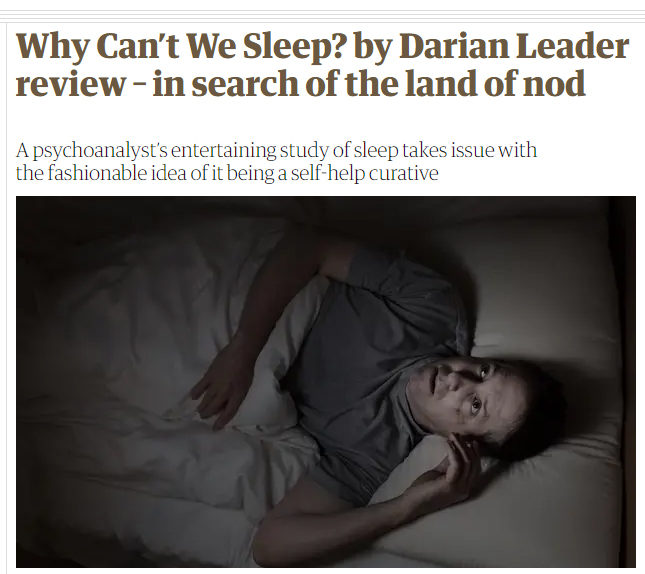 In the 1950s, researchers at Edinburgh University conducting a study into sleep concluded that there was little difference in sleep time between using a well-sprung mattress and a wooden board. Try telling that to retailers of £500 multilayered mattresses. For sleep, as the psychoanalyst Darian Leader reminds us in his richly researched and entertaining Why Can’t We Sleep?, has been commodified: it’s big business.
Before advancing reasons for insomnia, and why one in three adults complains of sleep difficulties, Leader delves into the history of sleep research and competing theories about why we sleep, which have culminated in a remarkable inversion of concern: a shift from anxiety causing problems with sleep to the present, where the lack of sleep leads to anxiety.
Some judgments, though, have resisted change. In the 1960s the eight-hour “ideal” sleep was shown by the researcher William Dement to be a “fallacy”, yet today, argues Leader, sleep experts promote eight hours as the desired gold standard – almost as a human right.
Leader rolls his eyes at the zeitgeist of the “new science of sleep”, with its notions of sleep as a self-help curative for ailments ranging from dementia to unhappiness, all achievable “with sensitive temperature control and software that will tailor the environment to their unique circadian rhythm”.
There’s no consensus on the point of sleep. But there is agreement that it is a time for the processing of memories internal body clocks’ association with sleep cycles have long been recognised, but sleep wasn’t always undertaken in one unbroken block. The historian Roger Ekirch argued that prior to the 19th century sleep was biphasic – taken in two parts with an hour or so in between when the person was awake.
With the Industrial Revolution, maintaining nonstop production lines necessitated shift work and changes to patterns of sleep. Today, businesses’ co-option of sleep in enhancing productivity is illustrated by firms such as Aetna offering $25-per-night rewards to employees (monitored via sleep trackers) who manage 20 nights of sleep for seven hours or more in a row.
Goal-oriented sleep research becomes problematic when it approximates the maxim: “What the thinker thinks the prover proves.” We might be inclined to look more closely at conclusions drawn by Nathaniel Kleitman’s classic 1939 study Sleep and Wakefulness, says Leader, when made aware that his university research “was heavily funded by corporate sponsors keen to engineer more productive workers”.
Leader also questions the value of extrapolating into the real world conclusions drawn from experiments carried out in unnatural environments. Contemplating the validity of experiments with patients isolated overnight in sleep clinics using EEG, he observes: ‘They don’t have sex with a bedfellow or masturbate, and yet this entirely artificial subject is the one we expect to give the real facts about sleep.”
… [Click here to read the rest of this article on the Guardian Site]
Darian Leader is speaking in Bristol at the CFAR/Bristol University Lecture Series on the 22nd of June 2019.
Freud, mental health, psychoanalysis, psychotherapy, talking treatment
Pope reveals he had weekly psychoanalysis sessions at age 42
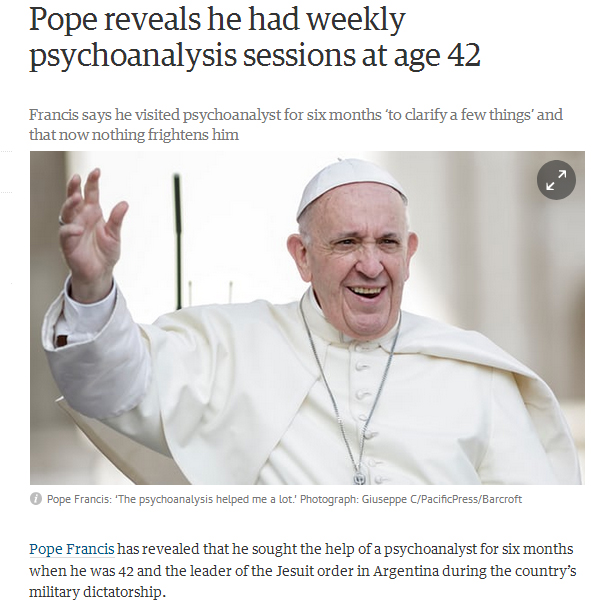
Pope Francis has revealed that he sought the help of a psychoanalyst for six months when he was 42 and the leader of the Jesuit order in Argentina during the country’s military dictatorship.
The pope’s disclosure was made in a book based on 12 in-depth interviews with the French sociologist Dominique Wolton, to be published next week.
Francis said the weekly sessions with the psychoanalyst helped him a lot. “For six months, I went to her home once a week to clarify a few things. She was a doctor and psychoanalyst. She was always there,” he told Wolton for the 432-page book Pope Francis: Politics and Society.
Freud, mental health, psychoanalysis, psychotherapy, talking treatment
Therapy Wars: The Revenge of Freud – Guardian Article by Oliver Burkeman
[Click here to visit the Guardian site and read Oliver Burkeman’s article.]
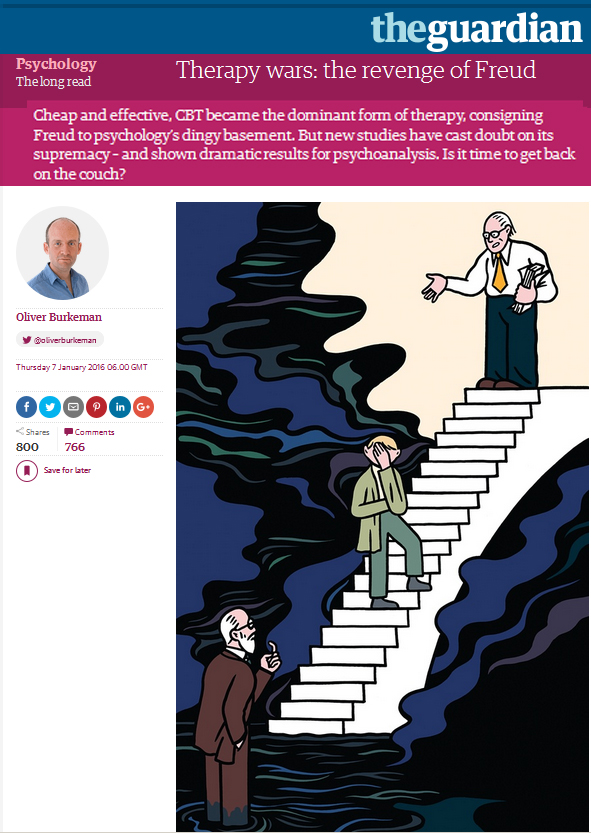
Cheap and effective, CBT became the dominant form of therapy, consigning Freud to psychology’s dingy basement. But new studies have cast doubt on its supremacy – and shown dramatic results for psychoanalysis. Is it time to get back on the couch?
“…researchers at London’s Tavistock clinic published results in October from the first rigorous NHS study of long-term psychoanalysis as a treatment for chronic depression. For the most severely depressed, it concluded, 18 months of analysis worked far better – and with much longer-lasting effects – than “treatment as usual” on the NHS, which included some CBT. Two years after the various treatments ended, 44% of analysis patients no longer met the criteria for major depression, compared to one-tenth of the others.”
Culture, Freud, Freud Museum, mental health, psychoanalysis, psychotherapy, talking treatment
What is Psychoanalysis? Part 4: The Ego, the Id and the Superego – Freud Museum

IN THIS EPISODE:
A fractured self
The ego, the id and the superego
Why did Freud develop a new model?
Devils and angels
People fall ill of their moral ideals
A horse and a rider
The ego is like a politician
The goal of analysis is to stop the ego being so silly
More info: www.freud.org.uk/education/
Culture, Freud, Freud Museum, psychoanalysis, psychotherapy, talking treatment
What is Psychoanalysis? Part 3: Oedipus Complex – Freud Museum London
Click here to see the third part of the Freud Museum introductory video series on psychoanalysis.
IN THIS EPISODE:
The emotional world of children
His Majesty the Baby
The mother as first love object
Is it sexual?
Jealousy, rivalry, hatred and anxiety
The role of the father
Gender: Freud didn’t think you were just ‘born a boy’ or ‘born a girl’
There is no perfect resolution of the Oedipus complex
It marks us for life
More info: www.freud.org.uk/education/
Freud, Freud Museum, psychoanalysis, psychotherapy, talking treatment
What is Psychoanalysis? Part 2: Sexuality – Freud Museum London
Click here to see the second part of the Freud Museum introductory video series on psychoanalysis.
IN THIS EPISODE:
An enlarged concept of sexuality
Infantile sexuality
Perversion is something we’re born with
Normal and abnormal
Psychosexual stages of development: oral, anal, phallic
Repression
Sexuality and symptoms
More info: www.freud.org.uk/education/
Culture, Freud, Freud Museum, Podcast, psychoanalysis, talking treatment
What is Psychoanalysis? Part 1: Is it Weird? Freud Museum London
[Click here to view the Freud Museum video on YouTube]
Series trailer for Freud Museum introductory videos on psychoanalysis featuring interviews with analysts including John Forrester, Anne Worthington, Dany Nobus, Darian Leader, Astrid Gessert, Daniel Pick and Anouchka Grose.
Artistic process, Culture, Freud, Podcast, psychoanalysis, psychotherapy, talking treatment
Anouchka Grose: The Unconscious from Freud to Lacan
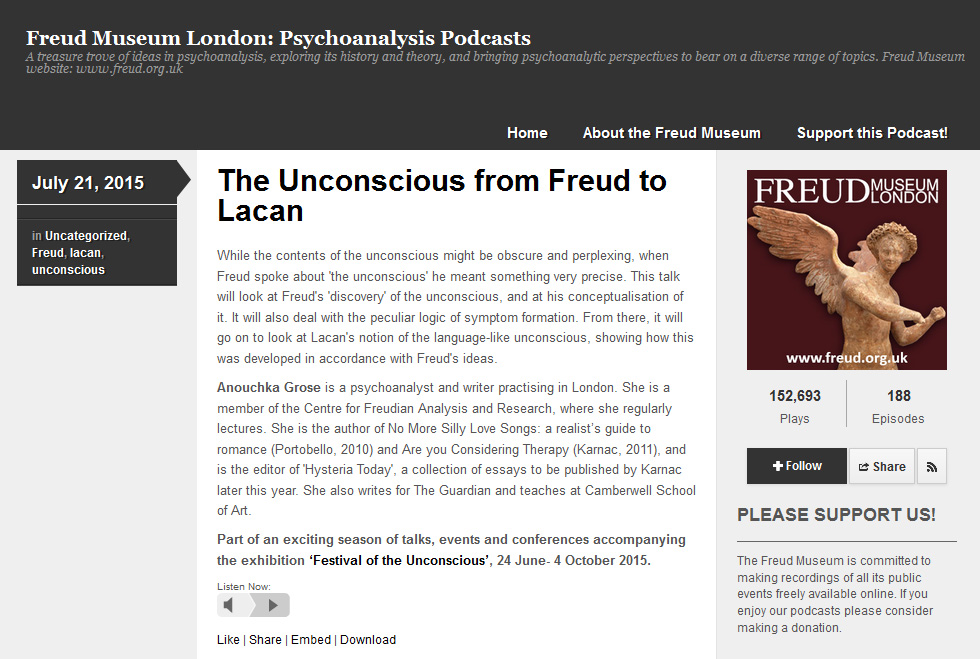
[Click here to visit the Freud Museum Site and hear the Podcast]
While the contents of the unconscious might be obscure and perplexing, when Freud spoke about ‘the unconscious’ he meant something very precise. This talk will look at Freud’s ‘discovery’ of the unconscious, and at his conceptualisation of it. It will also deal with the peculiar logic of symptom formation. From there, it will go on to look at Lacan’s notion of the language-like unconscious, showing how this was developed in accordance with Freud’s ideas.
Anouchka Grose is a psychoanalyst and writer practising in London. She is a member of the Centre for Freudian Analysis and Research, where she regularly lectures. She is the author of No More Silly Love Songs: a realist’s guide to romance (Portobello, 2010) and Are you Considering Therapy (Karnac, 2011), and is the editor of ‘Hysteria Today’, a collection of essays to be published by Karnac later this year. She also writes for The Guardian and teaches at Camberwell School of Art.
Artistic process, Culture, Feminism, Freud, Podcast, Poetry, psychoanalysis, psychotherapy, talking treatment
Why Remember? LSE Podcast with Lisa Appignanesi, Darian Leader & Owen Sheers
[Click here to go the the LSE site and listen to the podcast.]
Speaker(s): Lisa Appignanesi, Darian Leader, Owen Sheers
Chair: Professor Sandra Jovchelovitch
Recorded on 28 February 2015.
This panel explores our relationship with our sometimes traumatic past, and asks why we should remember and what happens when we can’t remember. The discussion considers the importance of place and landscape in memory, as well as the nature of collective memory and memorialisation, particularly in the context of war.
Lisa Appignanesi (@LisaAppignanesi) is a writer, novelist and broadcaster. She is the former Chair of the Freud Museum London, the former President of English PEN and former Deputy Director of London’s Institute of Contemporary Arts. Her non-fiction includes Mad, Bad and Sad: A History of Women and the Mind Doctors (which won the BMA Award for the Public Understanding of Science amongst other prizes), the acclaimed family memoir Losing the Dead, the classic study Freud’s Women (with John Forrester) and Simone de Beauvoir, and most recently Trials of Passion: Crimes in the Name of Love and Madness. Her novels include Paris Requiem, The Memory Man and The Dead of Winter. Lisa Appignanesi was awarded the OBE in 2013.
Darian Leader is a psychoanalyst working in London and a founder member of the Centre for Freudian Analysis and Research. He is President of the College of Psychoanalysts-UK and Visiting Professor at the School of Human and Life Sciences, Roehampton University. He is the author of several books including: Introducing Lacan, Why do women write more letters than they post?; Freud’s Footnotes; Stealing the Mona Lisa: What Art Stops Us From Seeing, Why do people get ill?’ (with David Corfield), The New Black: Mourning, Melancholia and Depression and What is Madness? His most recent book, Strictly Bipolar was published by Hamish Hamilton in 2013.
Owen Sheers (@owensheers) has written two collections of poetry, The Blue Book and Skirrid Hill, which won a Somerset Maugham award. His verse drama Pink Mist won Wales Book of the Year and the Hay Festival Poetry Medal. His non-fiction includes The Dust Diaries and Calon: A Journey to the Heart of Welsh Rugby. His first novel Resistance has been translated into ten languages and was made into a film in 2011. His plays include The Passion, The Two Worlds of Charlie F. and Mametz. Owen wrote and presented BBC Four’s A Poet’s Guide to Britain. He has been a NYPL Cullman Fellow, Writer in Residence for the Wordsworth Trust and Artist in Residence for the Welsh Rugby Union. His second novel I Saw A Man will be published by Faber in 2015